Pymca For X-ray
The ESRF: Just an X-Ray Source. Energy of emitted X rays is element dependent. PyMca is set of software tools on its way to become a reference in XRF. Welcome to the PyMca X-ray Fluorescence Toolkit Home Page. PyMca has been developed by the Software Group of the European Synchrotron.
Dear Angel, I have been checking Ebel's article (X-ray spectrometry 32 (2003) 46-51) and it would take me quite a bit of time to do a proper implementation. The expressions given in that article make use of average sub-shell fluorescent yields. Average sub-shell fluorescent yields depend on the distribution of primary vacancies. That article makes no difference on whether the K-shell is excited or not nor if all the L sub-shells are excited or not.
I consider a generic code as PyMca cannot assume that. To write the code to compute the distribution of characteristic L lines for all cases certainly requires more time than I have now because I would have to go through many of the references cited on that article to adapt the expressions.
If you, or any of the readers, can provide an alternative reference not using average fluorescence yields, I will take a closer look. In your case I would try to measure thin standards of Co, Cu, Ge, Ga and As to estimate the contribution of L lines. They should help you to figure out what is going on. Figure 10 on the above mentioned article, corrected by transmission through your Al filter, can help you too. Best regards, Armando Thread view.
Z-push for macbook pro. Dear Angel, I have been checking Ebel's article (X-ray spectrometry 32 (2003) 46-51) and it would take me quite a bit of time to do a proper implementation. The expressions given in that article make use of average sub-shell fluorescent yields. Average sub-shell fluorescent yields depend on the distribution of primary vacancies. That article makes no difference on whether the K-shell is excited or not nor if all the L sub-shells are excited or not. I consider a generic code as PyMca cannot assume that. To write the code to compute the distribution of characteristic L lines for all cases certainly requires more time than I have now because I would have to go through many of the references cited on that article to adapt the expressions.
If you, or any of the readers, can provide an alternative reference not using average fluorescence yields, I will take a closer look. In your case I would try to measure thin standards of Co, Cu, Ge, Ga and As to estimate the contribution of L lines. They should help you to figure out what is going on. Figure 10 on the above mentioned article, corrected by transmission through your Al filter, can help you too. Best regards, Armando.

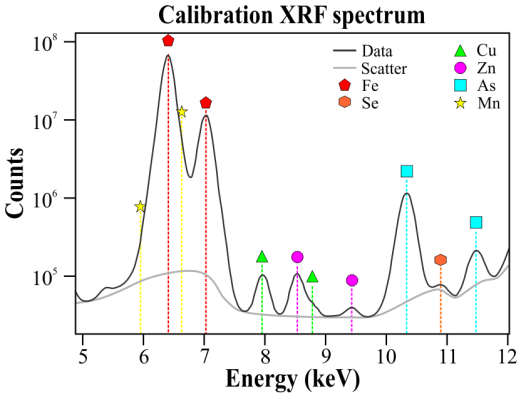
Dear Armando: Thank you for your answer. Concerning the L lines of the W lines I will try to find some reference that could help for a shorter implementation, however I must tell you that I a not a expert in XRF physics, I am a end user of XRF trying to make rutine quantitative analysis wit a portable equipment, so I have to figure out many of the aspects implemented in Pymca.
Ottawa Criteria For X Ray
After some weeks trying to undestand the X-ray profile adjustment, I do not find the 'logic' for changing the weigths for the recover of the correct concentrations of the standards, and I could not find any reference where the procedure of scaling, wheight recalculation etc. Is explained. I suposse that it can be complex to explain it but I would appreciate any help to understand how to proceed with the fitting of the profile. In any case I will follow trying test and error.
Cpt Code For X Ray Of Lumbar Spine
Best regards. ANGEL POLVORINOS.