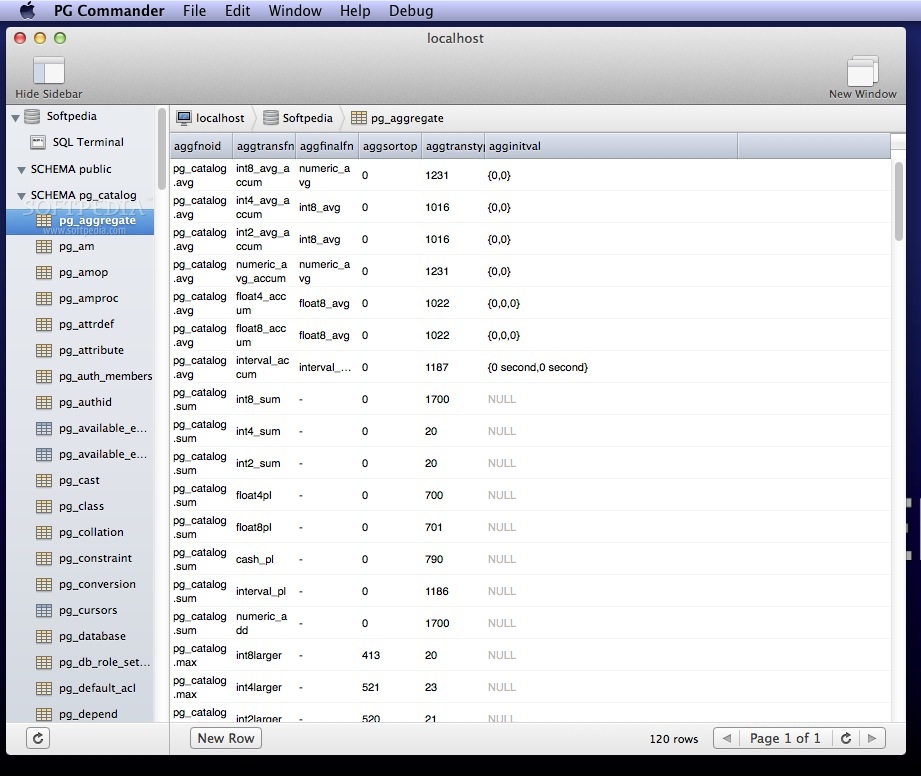
Pg Commander, A Postgresql Client For Mac
PgAdmin is the most popular and feature rich Open Source administration and development platform for PostgreSQL, the most advanced Open Source database in the world. PgAdmin may be used on Linux, Unix, Mac OS X and Windows to manage PostgreSQL 9.2 and above.
- PostgreSQL Clients. From PostgreSQL wiki. Jump to: navigation, search. For many years the 'standard' freely available GUI client for Postgresql, and so is bundled in many packaged installers. It provides a SQL query tool, an editor for procedural languages and a CRUD interface. Installers available for Windows, Mac and Linux.
- Sudo -u user psql user. The key is 'I installed the postgres.app for mac. So instead of this command: sudo -u postgres psql -U postgres, it would be more in.
I'm using the PostgreSql app for mac. I've used it in the past on other machines but it's giving me some trouble when installing on my macbook.
I've installed the application and I ran: psql -h localhost It returns: psql: FATAL: database ' does not exist It seems I can't even run the console to create the database that it's attempting to find. The same thing happens when I just run: psql or if I launch psql from the application drop down menu: Machine stats:. OSX 10.8.4. psql (PostgreSQL) 9.2.4 Any help is appreciated. I've also attempted to install PostgreSql via homebrew and I'm getting the same issue.
I've also read the applications documentation page that states: When Postgres.app first starts up, it creates the $USER database, which is the default database for psql when none is specified. The default user is $USER, with no password.
So it would seem the application is not creating $USER however I've installed-uninstalled-reinstalled several times now so it must be something with my machine. I found the answer but I'm not sure exactly how it works as the user who answered on this thread - didn't follow up.
I used the following command to get psql to open: psql -d template1 I'll leave this one unanswered until someone can provide an explanation for why this works. It appears that your package manager failed to create the database named $user for you.
Postgresql Mac Install
The reason that psql -d template1 works for you is that template1 is a database created by postgres itself, and is present on all installations. You are apparently able to log in to template1, so you must have some rights assigned to you by the database. Try this at a shell prompt: createdb and then see if you can log in again with psql -h localhost This will simply create a database for your login user, which I think is what you are looking for. If createdb fails, then you don't have enough rights to make your own database, and you will have to figure out how to fix the homebrew package.
Thanks @Kirk. Do we really need -d template1 in your first command? I've seen 'template1' in tutorials all over the Internet but it only serves to confuse me.
A more logical approach would be, in my opinion 1) Create the PostgreSQL user e.g. 'usera' 2) Create a database with the same name as the user 'usera' (I think this is crazy but it seems PostgreSQL requires it) 3) Log into PostgreSQL as the super user 'postgres' and assign the privileges of database 'usera' to the user 'usera' (oh my god, is this really the real life?) – Jul 22 '15 at 6:56. This error can also occur if the environment variable PGDATABASE is set to the name of a database that does not exist. On OSX, I saw the following error while trying to launch psql from the Postgress.app menu: psql: FATAL: database 'otherdb' does not exist The solution to the error was to remove export PGDATABASE=otherdb from /.bashprofile: Further, if PGUSER is set to something other than your username, the following error will occur: psql: FATAL: role 'note' does not exist The solution is to remove export PGUSER=notme from /.bashprofile.
As the states: The first database is always created by the initdb command when the data storage area is initialized. This database is called postgres.
So if certain OS/postgresql distributions do that differently, it is certainly not the default/standard (just verified that initdb on openSUSE 13.1 creates the DB 'postgres', but not '). Long story short, psql -d postgres is expected to be used when using a user other than 'postgres'. Obviously the accepted answer, running createdb to create a DB named like the user, works as well, but creates a superfluous DB. First off, it's helpful to create a database named the same as your current use, to prevent the error when you just want to use the default database and create new tables without declaring the name of a db explicitly.
Replace 'skynotify' with your username: psql -d postgres -c 'CREATE DATABASE skynotify ENCODING 'UTF-8';' -d explicitly declares which database to use as the default for SQL statements that don't explicitly include a db name during this interactive session. BASICS FOR GETTING A CLEAR PICTURE OF WHAT YOUR PostgresQL SERVER has in it. Helpmicrowave instructions for mac.
You must connect to an existing database to use psql interactively. Fortunately, you can ask psql for a list of databases: psql -l.
Oct 26, 2012. This is a quick guide for installing ( Postgres for short) on a Mac with, and starting and stopping it with.
If you've just forked a Ruby on Rails project that requires Postgres, this tutorial will get you up and running in no time. If you're working on a brand new Rails app and need to create a new Postgres user and database for your app, I recommend. Step 1: Install Homebrew To make sure you have all the tools necessary for Ruby on Rails development, I recommend you follow my tutorial for. Step 2: Update Homebrew Before you install anything with Homebrew, you should always make sure it's up to date and that it's healthy: $ brew update $ brew doctor Step 3: Install Postgres $ brew install postgresql When you install Postgres, you will see a bunch of output in your Terminal that looks like this: The important sections are Build Notes, Create/Upgrade a Database, and Start/Stop PostgreSQL. Make sure to follow those instructions to the letter. Step 4: Create/Upgrade a database If this is your first time installing Postgres with Homebrew, you'll need to create a database with: $ initdb /usr/local/var/postgres -E utf8 I copied and pasted that command directly from the Terminal output.
You should do the same, in case the instructions change in the future. Step 5: Install Lunchy $ gem install lunchy Lunchy is a helpful gem that will allow you to easily start and stop Postgres. Step 6: Start/Stop Postgres Once again, I'm copying and pasting the following commands from my Terminal. Note that the second command is specific to the version of Postgres that was installed on my machine. If the version number has changed since I've written this tutorial, using the command below won't work for you, so you should make sure to copy the command from your Terminal output.
Free Postgresql Client
$ mkdir -p /Library/LaunchAgents $ cp /usr/local/Cellar/postgresql/9.2.1/homebrew.mxcl.postgresql.plist /Library/LaunchAgents/ Since we're using Lunchy, we don't need to run this third command: $ launchctl load -w /Library/LaunchAgents/homebrew.mxcl.postgresql.plist Instead, we'll simply use this to start Postgres: $ lunchy start postgres At this point, you should be all set to run the rake commands to create and use the database for the existing Rails app you're working on. To stop Postgres: $ lunchy stop postgres.