Mysql Workbench Alternatives For Mac
. (GPL) (Current Generally Available Release: 8.0.13) MySQL Community Server is the world's most popular open source database. (GPL) (Current Generally Available Release: 7.6.8) MySQL Cluster is a real-time, open source transactional database. (GPL) (Current Generally Available Release: 8.0.13) MySQL Router is lightweight middleware that provides transparent routing between your application and any backend MySQL Servers.
As an added advantage, MySQL Workbench also promises to helps you migrate Microsoft SQL Server, PostreSQL, Sybase ASE, RDBMS tables, data and objects to MySQL. Hence, you can quickly convert existing apps to run on MySQL both on Mac OS X, Windows, as well as other platforms.
(GPL) (Current Generally Available Release: 8.0.13) The MySQL Shell is an interactive Javascript, Python, or SQL interface supporting development and administration for the MySQL Server and is a component of the MySQL Server. (GPL) (Current Generally Available Release: 8.0.13) MySQL Workbench is a next-generation visual database design application that can be used to efficiently design, manage and document database schemata. It is available as both, open source and commercial editions. MySQL offers standard database driver connectivity for using MySQL with applications and tools that are compatible with industry standards ODBC and JDBC. (Current Generally Available Release: 8.0.13) MySQL provides you with a suite of tools for developing and managing MySQL-based business critical applications on Windows. MySQL provides a YUM software repository to simplify installing and updating MySQL products on a variety of Linux operating systems.
MySQL provides an APT-style software repository for installing the MySQL server, client, and other components on a variety of Linux operating systems. The MySQL repository for SUSE Linux provides a simple and convenient way to install and update MySQL products with the latest software packages using the Zypper package management tool.
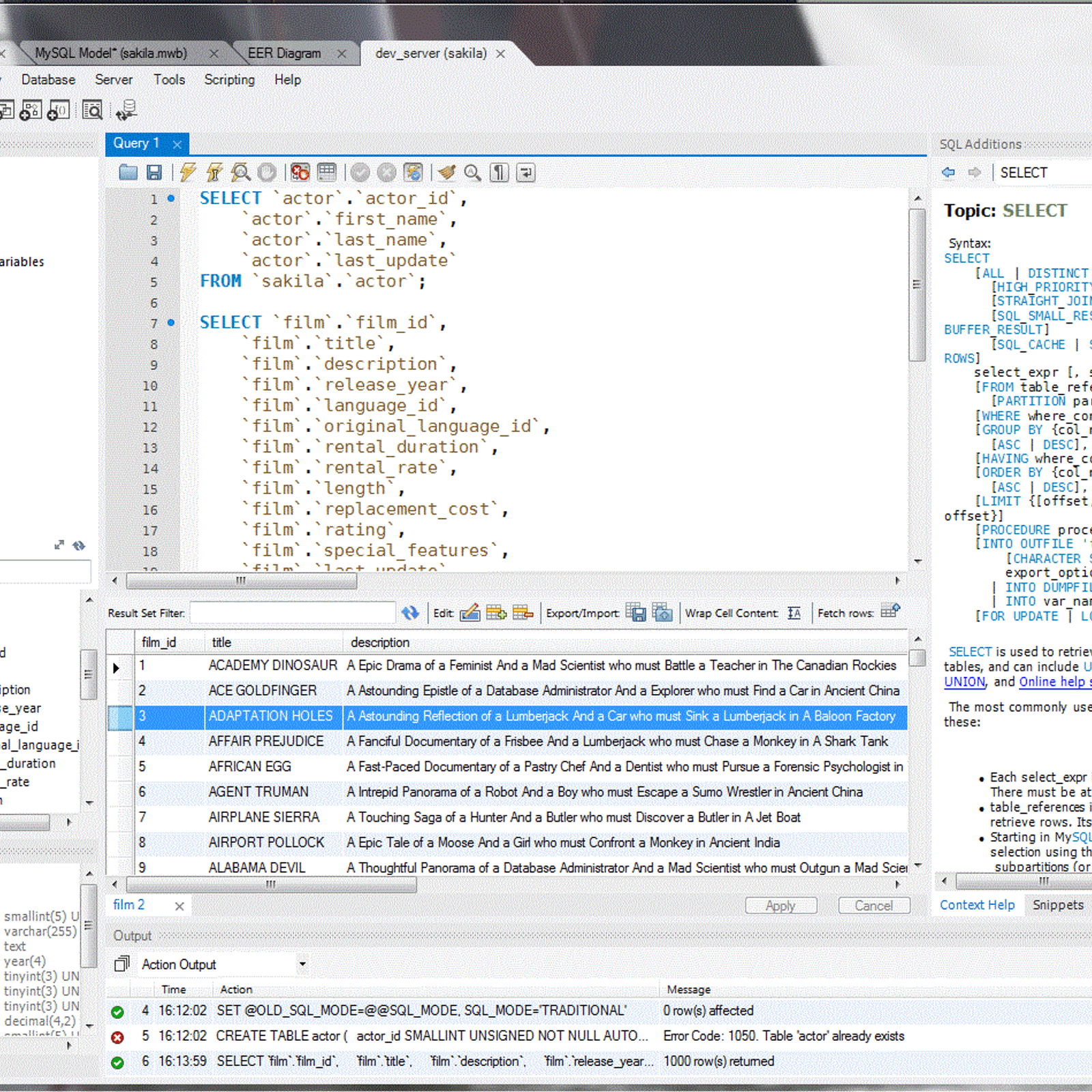
The procedure for launching MySQL Workbench depends on the platform. Generally, there are two ways to launch MySQL Workbench from the command line and from the graphical user interface of the host operating system. Using the command-line launching facility is useful when you want to customize some aspects of the way MySQL Workbench operates. Launching MySQL Workbench for each of the supported platforms is described in the following sections. In addition to platform-specific command line options, MySQL Workbench has the following command line options.
Important Installing MySQL Workbench using the installer requires either Administrator or Power User privileges. If you are using the ZIP file without an installer, you do not need Administrator or Power User privileges. Improving the MySQL Installation Wizard depends on the support and feedback of users. If you find that the MySQL Installation Wizard is lacking some feature important to you, or if you discover a bug, please report it in our bugs database. To do this use the Report a Bug option under the Help menu. To install MySQL Workbench, right-click the MSI file and select the Install option from the pop-up menu, or simply double-click the file.
In the Setup Type window you may choose a Complete or Custom installation. To use all features of MySQL Workbench choose the Complete option. Unless you choose otherwise, MySQL Workbench is installed in C:%PROGRAMFILES% MySQL MySQL Workbench 5.1 editiontype, where%PROGRAMFILES% is the default directory for programs for your locale. The%PROGRAMFILES% directory may be C: Program Files or C: programme.
Installing from the ZIP File If you are having problems running the installer, as an alternative, you can download a ZIP file without an installer. That file is called mysql-workbench- version-win32.zip. Using a ZIP utility, unpack it to the directory of your choice. You may also want to create a shortcut on your desktop or the quick launch bar.
To install using the ZIP file, download the ZIP file to a convenient location and decompress the file. You can place the resulting directory anywhere on you system. You do not need to install or configure the application before using it. Launching MySQL Workbench on Windows To start MySQL Workbench on Windows select Start, Programs, MySQL and then select MySQL Workbench. You may also start MySQL Workbench from the command line. To view the available command-line options, issue the command MySQLWorkbench -help more from the MySQL Workbench installation directory.
You will see the following output: MySQL Workbench 5.1.12 OSS. (C) 2006-2009 by Sun Microsystems. All rights reserved. Usage: MySQLWorkbench options model file Options -help (-h). Print this output -open filename.
Open the given filename at startup -nologo. Do not display the splash screen -verbose (-v). Print verbose output in the GRT Shell -version. Print the version information -grtversion.
Print the GRT version information -swrendering. Force the canvas to use software rendering instead of OpenGL -log. Instruction to save messages (other debug info) to file The MySQL Workbench version number is displayed followed by a usage message and then the options. Use the -swrendering option if your video card does not support OpenGL 1.5. The -version option can be used to display the MySQL Workbench version number. The -grtversion can be used to display the GRT shell version number. The other options are self-explanatory.
Mysql Workbench Mac Os
Note It is not possible to remove MySQL Workbench from the command line if you have installed MySQL Workbench using the installer. Although you can manually remove some of the compoentns There is no command-line option for removing MySQL Workbench. Removing the MySQL Workbench directory manually will not remove all the files belonging to MySQL Workbench.
When installed from a ZIP file If you installed MySQL Workbench using a ZIP file, to remove MySQL Workbench you can just delete the MySQL Workbench directory. Fedora 10 amd64 (RPM). Ubuntu 8.04 i386 (DEB). Ubuntu 8.10 amd64 (DEB) In addition to the binary distributions, it is also possible to download the MySQL Workbench source code as a tar.gz or RPM package.
Check the MySQL Workbench for the latest packages. The procedure for installing on Linux depends on which Linux distribution you are using. Installing DEB packages On Ubuntu, and other systems that use the Debian package scheme, you can install MySQL Workbench using a command such as: shell sudo dpkg -i package.deb Note that package.deb will be the MySQL Workbench package, for example, mysql-workbench-oss- versioni386.deb, where version is the MySQL Workbench version number. Note You may be warned that certain libraries are not available, depending on what you already have installed.
Is Mysql Workbench Free
Install the required libraries and then install the MySQL Workbench package again. Installing RPM packages On RedHat-based systems, and other systems using the RPM package format, MySQL Workbench can be installed by a command such as: shell sudo rpm -i package.rpm Again, note that package.rpm will be the MySQL Workbench package, for example, mysql-workbench-oss- version-1fc10.x8664.rpm, and version is the MySQL Workbench version number. Launching MySQL Workbench on Linux Once MySQL Workbench has been installed it can be launched by selecting Applications, Programming, MySQL Workbench from the main menu. MySQL Workbench can also be launched from the command line on Linux. Type the command: shell /usr/bin/mysql-workbench -help This will display the available command-line options: mysql-workbench Options: -force-sw-render Force Xlib rendering -force-opengl-render Force OpenGL rendering -help, -h Show command line options and exit. Uninstalling MySQL Workbench on Linux The procedure for uninstalling MySQL Workbench on Linux depends on the packe you are using.
Mysql Workbench Mac
Uninstalling DEB packages For Debian packages the command is: shell sudo dpkg -r mysql-workbench-oss This does not remove the configuration files. If you wish to also remove the configuration files use: shell sudo dpkg -purge mysql-workbench-oss Uninstalling RPM packages To uninstall RPM packages use: shell sudo rpm -e mysql-workbench-oss This does not remove the configuration files.