Epm Dashboard Access For Mac
McAfee menulet for easy access — Access the McAfee menulet to launch the McAfee. For Mac dialog box. • Dashboard — View the security status of your Mac, scheduled scan tasks, latest events,. Sudo /usr/local/McAfee/uninstall EPM. Microsoft BI Dashboard Solution for Hyperion Essbase 7.1.2. My company is looking to implement a dashboard solution for Hyperion Essbase 7.1.2. The inclination is towards using Micrsofts BI for doing the same. I am struggling to find a MS BI product which could be given a thought incase Native dashboard.
The MR supports a wide variety of encryption and authentication methods— from simple, open access to WPA2-Enterprise with 802.1x authentication. Encryption and authentication are configured in the MCC under the Configure tab on the Access Control page. Generally speaking, the encryption method is configured under “Association requirements”, while the authentication method is configured under “Network sign-on method”. To associate to a wireless network, a client must have the correct encryption keys (association requirements). Once associated the wireless client may need to enter information (network sign-on method) before accessing resources on the wireless network.
The combinations of encryption and authentication methods that are supported are as follows. Open System Authentication Open mode allows any device to connect to the wireless network. The major advantage of open mode is its simplicity: Any client can connect easily and without complex configuration. Open mode is recommended when there are guests who need to get onto the network, or more generally, when ease of connectivity is paramount and access control is not required. In most environments, the administrator should ensure that wireless clients associated on an open network cannot access LAN resources, such as file shares. Administrators can control access using,.
MAC-based Access Control MAC-based access control admits or denies wireless association based on the connecting device’s MAC address. When a wireless device attempts to associate, the Meraki AP queries a customer-premise RADIUS server with an Access-Request message. The RADIUS server can admit or deny the device based on the MAC address, responding to the Meraki AP with either an Access- Accept message or an Access-Reject message, respectively.
This authentication method requires no client-side configuration. However, it suffers from a poor user experience. Wireless clients that are denied wireless association simply cannot connect to the SSID, and they do not receive any explicit notification about why they cannot connect. If this authentication method is selected, at least 1 RADIUS server must be configured on the Access Control page in the “RADIUS for MAC-based access control” section. This section includes a test tool that simulates the wireless device connecting to every Meraki AP in the network. See the on how to get started with MAC-based access control. A pre-shared key (PSK) allows anyone who has the key to use the wireless network.
Wired Equivalent Privacy (WEP) is the original 802.11 pre-shared key mechanism, utilizing RC4 encryption. WEP is vulnerable to being hacked; the encryption key can be derived by an eavesdropper who sees enough traffic. Only use WEP if it is not possible to utilize more advanced security—for instance, when there are legacy client devices in the network that do not support WPA/WPA2. See the on how to configure WEP encryption on a SSID.
WPA- and WPA2-Personal (Wi-Fi Protected Access) use stronger encryption than WEP. (WPA-Personal uses TKIP with RC4 encryption, while WPA2- Personal uses AES encryption.) WPA2-Personal is preferred. Though it requires some client-side configuration, a PSK is relatively easy to configure.
It can be a good choice when there is a small number of users or when clients do not support more sophisticated authentication mechanisms, such as WPA2-Enterprise. A deployment based on a PSK does not scale well, however. With a large number of users, it becomes more difficult to change the PSK, an operation that should be performed periodically to ensure that the PSK has not been shared with unwanted users.

See the on how to configure WPA encryption on a SSID. WPA2-Enterprise with 802.1X Authentication 802.1X is an IEEE standard framework for encrypting and authenticating a user who is trying to associate to a wired or wireless network. WPA-Enterprise uses TKIP with RC4 encryption, while WPA2-Enterprise adds AES encryption. 802.1X can be transparent to wireless users. For example, Windows machines can be configured for single sign-on, such that the same credentials that a user enters to log into his machine are passed automatically to the authentication server for wireless authentication. The user is never prompted to re-enter his credentials.
802.1X utilizes the Extensible Authentication Protocol (EAP) to establish a secure tunnel between participants involved in an authentication exchange. The MR supports multiple EAP types, depending on whether the network is using a Meraki-hosted authentication server or a customer-hosted authentication server. The following table shows the EAP types supported by the MR access points: WPA2-Enterprise with 802.1X authentication is configured to use a customer-hosted on-premise Custom RADIUS server. The RADIUS server must be configured to allow authentication requests from the IP addresses of the Meraki access points. Identity Sources WPA2-Enerprise requires a identity source in order to authenticate users when they connect to the network. The Access points each interface with the identity source at time of the client association.
Below are the identiity sources that can be used with WPA2-Enterprise. Meraki RADIUS - Cloud Hosted. Network-wide Users can connect and login with PEAP and EAP-TTLS. WiFi Security configures endpoint devices to connect with. Customer Hosted.
Cisco Identity Services Engine (ISE). FreeRADIUS. Juniper Steel-Belted RADIUS or UAC.
ForeScout CounterACT. Aruba Clearpass.
Oracle Smart View for Office Analyze, Update and Report Oracle Smart View for Office (Smart View) provides a common Microsoft Office interface designed specifically for Oracle's Enterprise Performance Management (EPM) and Business Intelligence (BI). Using Smart View, you can view, import, manipulate, distribute and share data in Microsoft Excel, Word and PowerPoint interfaces. It is a comprehensive tool for accessing and integrating EPM and BI content from Microsoft Office products.
Ad hoc or Free-form Analysis for EPM & BI data in Office. Predefined Form Interaction. Report Design. Pre-Created Content Access. Ad hoc or Free-form Analysis for EPM and BI Data in Office This is for users requiring an environment to have a conversation with the data. Typically they use the Excel environment to interactively investigate the data contained in the source(s).
They may start with templates that begin the process (such as East Cola Sales) or a blank sheet where they begin shaping and altering the grids of data as they use the exposed functionality. Typically users go after the data from Oracle EPM on-premises sources such as Essbase, Planning or Financial Management using clicks and drag-and-drop. Other data sources supported for ad hoc analysis includes Oracle Business Intelligence Enterprise Edition, and Oracle EPM Cloud sources such as Oracle Planning and Budgeting Cloud. Predefined Form Interaction EPM application users that execute predefined input/reporting forms find Smart View a convenient way of completing tasks within the Office environment. These users would be planners, consolidators and the like that have a desire to work in the Excel environment either for consistent experience compared to the web application or to tie other spreadsheet-based models into their process. For example, Pepsi Bottling uses Smart View for Planning in order to incorporate data still housed in spreadsheet and workbook-based models. Report Design Reporting is another dimension of Smart View usage which leverages the capabilities of EPM data retrieves.
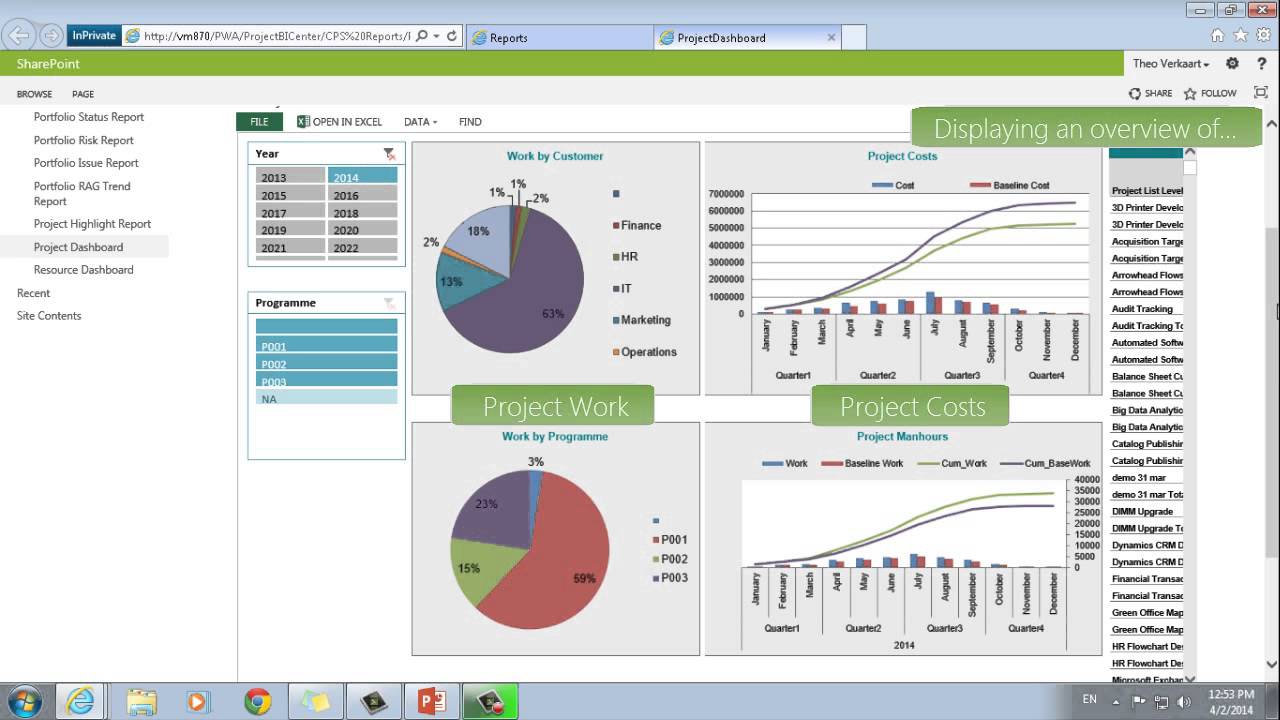
Once the data is available within Office we can create reports as needed based on a combination of data sources. For example Planning and Financial Management data could be used to compare actual to budget. Reports could be made more complex by providing the ability to compare multiple scenarios and different periods. The power of Office can be used to create reports in the Office environment and these reports can be refreshed periodically as needed.
Epm Dashboard Access For Mac Download
Pre-Created Content Access Another area of use is for importing pre-created content—for example, importing charts or grids from Oracle Hyperion Financial Reporting and Oracle Business Intelligence Enterprise Edition to PowerPoint, Word, or Excel. The imported content can be refreshed from the Office environment.