Antigen Presentation To Human T Lymphocytes. Ii
The adoptive transfer of antigen-specific cytotoxic T lymphocytes (CTLs) is a promising therapeutic approach for a number of diseases. To overcome the difficulty in generating specific CTLs, we established stable artificial antigen-presenting cells (AAPCs) that can be used to stimulate T cells of any patient of a given human leukocyte antigen (HLA) type. Mouse fibroblasts were retrovirally transduced with a single HLA–peptide complex along with the human accessory molecules B7.1, ICAM-1, and LFA-3. These AAPCs consistently elicit strong stimulation and expansion of HLA-restricted CTLs. Owing to the high efficiency of retrovirus-mediated gene transfer, stable AAPCs can be readily engineered for any HLA molecule and any specific peptide.
Rosenberg, S.A. Immunotherapy and gene therapy of cancer. 51, 5074s–5079s (1991). T-cell immunotherapy of tumors by adoptive transfer of cytotoxic T lymphocytes and by vaccination with minimal essential epitopes. 145, 167 –177 (1995). Riddell, S.R. & Greenberg, P.D.
Nature of the antigenic complex recognized by T lymphocytes. Analysis with an in vitro primary response to soluble protein antigens. Type II alveolar epithelial cells (AECII) are well known for their role in the innate immune system. More recently, it was proposed that they could play a role in the antigen presentation to T lymphocytes but contradictory results have been published both concerning their surface expressed molecules.
Principles for adoptive T cell therapy of human viral diseases. 13, 545–586 (1995). Rooney, C.M., Heslop, H.E. & Brenner, M.K. EBV specific CTL: a model for immune therapy. 2, 497–498 ( 1998). O'Reilly, R.J.
Adoptive immunotherapy for Epstein–Barr virus-associated lymphoproliferative disorders complicating marrow allografts. Springer Semin.
20, 455– 491 (1998). Lanzavecchia, A., Lezzi, G.
From TCR engagement to T cell activation: a kinetic view of T cell behavior. Cell 96, 1– 4 (1999).
7. Costimulation: building an immunological synapse comment. Science 283, 649– 650 (1999). 8. Banchereau, J.
& Steinman, R.M. Dendritic cells and the control of immunity. Nature 392, 245– 252 (1998). 9.
The immunological synapse: a molecular machine controlling T cell activation see comments. Science 285, 221–227 (1999). Topology and affinity of T-cell receptor mediated recognition of peptide–MHC complexes. 5, 45–49 ( 1993). Lenschow, D.J., Walunas, T.L.
& Bluestone, J.A. CD28/B7 system of T cell costimulation. 14, 233–258 (1996). & Dustin, M.L.
Making the T cell receptor go the distance: a topological view of T cell activation. Immunity 6, 361–369 (1997). & DeBenedette, M.A. T cell co-stimulatory molecules other than CD28. 11, 286–293 (1999).
Parra, E., Wingren, A.G., Hedlund, G., Kalland, T. & Dohlsten, M. The role of B7-1 and LFA-3 in costimulation of CD8 + T cells. 158, 637–642 (1997).
B7.1 is a quantitatively stronger costimulus than B7.2 in the activation of naive CD8 + TCR-transgenic T cells. 161, 5268–5275 (1998). & Mescher, M.F. ICAM-1 and B7-1 provide similar but distinct costimulation for CD8 + T cells, while CD4 + T cells are poorly costimulated by ICAM-1.
29, 45–53 ( 1999). Bednarek, M.A. The minimum peptide epitope from the influenza virus matrix protein. Extra and intracellular loading of HLA-A2. 147, 4047–4053 ( 1991). Identification of the nonamer peptide from influenza A matrix protein and the role of pockets of HLA-A2 in its recognition by cytotoxic T lymphocytes.
22, 903– 907 (1992). 19.
Identification of the immunodominant peptides of the MART-1 human melanoma antigen recognized by the majority of HLA-A2-restricted tumor infiltrating lymphocytes. 180, 347–352 (1994). Parkhurst, M.R. Improved induction of melanoma-reactive CTL with peptides from the melanoma antigen gp100 modified at HLA-A.0201-binding residues. 157, 2539–2548 (1996).
Serological analysis of Melan-A(MART-1), a melanocyte-specific protein homogeneously expressed in human melanomas. USA 93, 5915–5919 (1996). Endogenously synthesized peptide with an endoplasmic reticulum signal sequence sensitizes antigen-processing mutant cells to class I-restricted cell-mediated lysis. 174, 489 –492 (1991).
& Cresswell, P. Processing and delivery of peptides presented by MHC class I molecules. 8, 59–67 (1996). Sprent, J., Cai, Z., Brunmark, A., Jackson, M.R. & Peterson, P.A. Constructing artificial antigen-presenting cells from Drosophila cells. 417, 249–254 (1997).
Antigen-presenting cells. Professionals and amateurs. 5, 1095–1097 ( 1995).
Mellman, I., Turley, S.J. & Steinman, R.M.
Antigen processing for amateurs and professionals. Trends Cell Biol.
8, 231– 237 (1998). 27. Spagnoli, G.C. Peptide-specific CTL in tumor infiltrating lymphocytes from metastatic melanomas expressing MART-1/Melan-A, gp100 and Tyrosinase genes: a study in an unselected group of HLA-A2.1-positive patients.
Cancer 64, 309–315 (1995). Rivoltini, L. Binding and presentation of peptides derived from melanoma antigens MART-1 and glycoprotein-100 by HLA-A2 subtypes. Implications for peptide-based immunotherapy. 156, 3882–3891 (1996). & Rosenberg, S.A.
Immunobiology of human melanoma antigens MART-1 and gp100 and their use for immuno-gene therapy. 14, 173–192 (1997). Effects of CD28 costimulation on long-term proliferation of CD4 + T cells in the absence of exogenous feeder cells. 159, 5921–5930 (1997). Brenner, M.K., Heslop, H.E. & Rooney, C.M.
Gene and cell transfer for specific immunotherapy. 2, 87–90 (1998).
Long-term restoration of immunity against Epstein–Barr virus infection by adoptive transfer of gene-modified virus-specific T lymphocytes. 2, 551–555 (1996). 33. Schultze, J.L.
CD40-activated human B cells: an alternative source of highly efficient antigen-presenting cells to generate autologous antigen-specific T cells for adoptive immunotherapy. 100, 2757–2765 (1997). Antigen-dependent CD28 signaling selectively enhances survival and proliferation in genetically modified activated human primary T lymphocytes. 188, 619– 626 (1998). 35. Cancer patient T cells genetically targeted to prostate-specific membrane antigen specifically lyse prostate cancer cells and release cytokines in response to prostate-specific membrane antigen. Neoplasia 1, 123–127 (1999).
Riviere, I., Brose, K. & Mulligan, R.C. Effects of retroviral vector design on expression of human adenosine deaminase in murine bone marrow transplant recipients engrafted with genetically modified cells. USA 92, 6733–6737 (1995). Gallardo, H.F., Tan, C. & Sadelain, M. The internal ribosomal entry site of the encephalomyocarditis virus enables reliable coexpression of two transgenes in human primary T lymphocytes.
4, 1115–1119 (1997). 38. Ory, D.S., Neugeboren, B.A.
& Mulligan, R.C. A stable human-derived packaging cell line for production of high titer retrovirus/vesicular stomatitis virus G pseudotypes.
USA 93, 11400– 11406 (1996). & Sadelain, M. In Gene therapy protocols (ed. Robbins, P.D) 59–78 (Humana Press, Totowa, NJ; 1997).
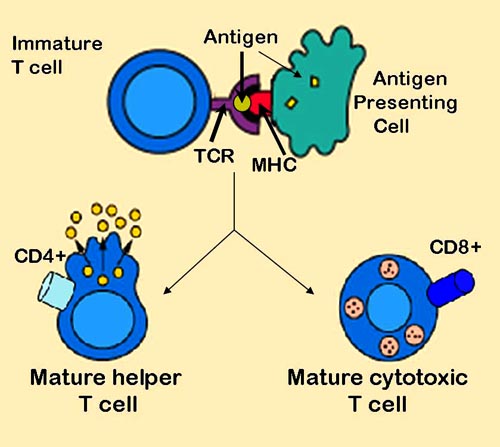
Antigen presentation stimulates T cells to become either 'cytotoxic' CD8+ cells or 'helper' CD4+ cells. An antigen-presenting cell ( APC) or accessory cell is a that displays complexed with (MHCs) on their surfaces; this process is known as.
May recognize these complexes using their (TCRs). These cells antigens and present them to T-cells.
Almost all cell types can serve as some form of APC. They are found in a variety of tissue types. Professional antigen-presenting cells, including, and, present foreign antigens to, while other cell types can present antigens originating inside the cell to. In addition to the MHC family of proteins, antigen presentation relies on other specialized signaling molecules on the surfaces of both APCs and T cells. Antigen-presenting cells are vital for effective, as the functioning of both cytotoxic and helper T cells is dependent on APCs. Antigen presentation allows for specificity of adaptive immunity and can contribute to immune responses against both intracellular and extracellular pathogens. It is also involved in defense against tumors.
Some therapies involve the creation of to prime the adaptive immune system to target malignant cells. Contents. Types and functions Antigen-presenting cells fall into two categories: professional and non-professional. Those that express MHC class II molecules along with co-stimulatory molecules and are often called professional antigen-presenting cells. The non-professional APCs express MHC class I molecules. T cells must be activated by interacting with a professional APC presenting an antigen which their T cell receptor recognizes before they can divide and perform their function. The APC involved in activating T cells is usually a dendritic cell.
T cells cannot recognize and therefore cannot respond to, 'free' or soluble antigens. They can only recognize and respond to antigen that has been processed and presented by cells via carrier molecules like MHC molecules. Helper T cells can recognize exogenous antigen presented on MHC class II; cytotoxic T cells can recognize endogenous antigen presented on MHC class I. Most cells in the body can present antigen to cells via MHC class I; however, the term 'antigen-presenting cell' is often used specifically to describe professional APCs.
Such cells express MHC class I and MHC class II molecules and can stimulate CD4+ helper T cells as well as cytotoxic T cells. APCs can also present foreign and self to T cells and by using the family of proteins, which are structurally similar to the MHC class I family. Professional Professional APCs specialize in presenting antigen to T cells. They are very efficient at internalizing antigens, either by (macrophages and dendritic cells) or by (B cells), processing the antigen into peptide fragments and then displaying those peptides, bound to a class II MHC molecule, on their membrane.
The T cell recognizes and interacts with the antigen-class II MHC molecule complex on the membrane of the antigen-presenting cell. An additional co-stimulatory signal is then produced by the antigen-presenting cell, leading to activation of the T cell. The expression of co-stimulatory molecules and MHC class II are defining features of professional APCs.
All professional APCs also express MHC class I molecules as well. The main types of professional antigen-presenting cells are dendritic cells, macrophages and B cells. Dendritic cells (DCs) have the broadest range of antigen presentation and are necessary for activation of naive T cells.
DCs present antigen to both helper and cytotoxic T cells. They can also perform, a process by which they present exogenous antigen on MHC class I molecules to cytotoxic T cells. Cross-presentation allows for the activation of these T cells. Dendritic cells also play a role in, which contributes to prevention of. Prior to encountering foreign antigen, dendritic cells express very low levels of MHC class II and co-stimulatory molecules on their cell surface. These immature dendritic cells are ineffective at presenting antigen to T helper cells.
Once a dendritic cell's pattern-recognition receptors recognize a pathogen-associated molecular pattern, antigen is phagocytosed and the dendritic cell becomes activated, upregulating the expression of MHC class II molecules. It also upregulates several co-stimulatory molecules required for T cell activation, including and B7. The latter can interact with on the surface of a CD4+ T cell. The dendritic cell is then a fully mature professional APC. It moves from the tissue to lymph nodes, where it encounters and activates T cells. Macrophages can be stimulated by T cell secretion of interferon gamma. After this activation, macrophages are able to express MHC class II and co-stimulatory molecules, including the B7 complex and can present phagocytosed peptide fragments to helper T cells.
Activation can assist pathogen-infected macrophages in clearing the infection. Deriving from a, type of, they will circulate the blood and enter affected sites and differentiate from monocytes to macrophages. At the affected site, the macrophage surrounds the site of infection or tissue damage with its membrane in a mechanism called. B cells can internalize antigen that binds to their B cell receptor and present it to helper T cells.
Unlike T cells, B cells can recognize soluble antigen for which their B cell receptor is specific. They can then process the antigen and present peptides using MHC class II molecules. When a T helper cell with a TCR specific for that peptide binds, the B cell marker CD40 binds to CD40L on the T cell surface. When activated by a T cell, a B cell can undergo antibody isotype switching, affinity maturation, as well as formation of memory cells.
Non-professional Non-professional antigen presenting cells include all nucleated cell types in the body. They use an MHC class I molecule coupled to to display endogenous peptides on the cell membrane. These peptides originate within the cell itself, in contrast to the exogenous antigen displayed by professional APCs using MHC class II molecules. Are able to interact with endogenous antigen presented using an MHC class I molecule. Non-professional APCs do not typically express MHC class II molecules.
However, it has been observed that antigen presentation to CD4+ cells via MHC class II is not restricted to the classically professional APCs. Other leukocytes, including granulocytes such as mast cells and neutrophils, can be induced to do so, as can endothelial and epithelial cells under certain circumstances. Even so, there is little evidence that these atypical APCs are able to activate naive CD4+ T cells. Interaction with T cells After dendritic cells have phagocytosed pathogens, they usually migrate to the vast network of and are carried by lymph flow to the draining.
Each lymph node is a collection point where APCs can interact with T cells. During the migration, DCs undergo a process of maturation: they lose most of their ability to further engulf pathogens and they mature by changing surface expression of MHC and co-stimulatory molecules, as well as increased production of cytokines.
Being Human T Shirts By Salman Khan
The internalized antigen is digested into smaller peptides containing, which are then presented to T cells by the MHC. B cells reside in the lymph node. Once their B cell receptor binds to an antigen, they can interact with activated helper T cells, as described above. A dendritic cell that interacts with an already-activated helper T cell can become licensed. This occurs through the interaction of co-stimulatory molecules including B7 and CD40 on the dendritic cell, with CD28 and CD40 ligand on the T cell. Only licensed dendritic cells are able to activate cytotoxic T cells.
Cytotoxic T Lymphocyte Antigen 4
T cell licensing of dendritic cells is key for activation of cytotoxic T cells for many pathogens, although the extent to which T cell help is needed may vary. In MHC class I and class II molecules, only certain epitopes of an internalized peptide can be presented. These epitopes are termed immunodominant.
Merge word for mac. In cancer therapy APCs naturally have a role in fighting tumors, via stimulation of B and cytotoxic T cells to respectively produce antibodies against tumor-related antigen and kill malignant cells. Dendritic cells, presenting tumor-specific antigen to T cells, are key to this process. Cancer therapies have included treating the patient with increased numbers of dendritic cells or cancer-specific T cells.
However, newer therapies have turned to genetically engineered artificial antigen-presenting cells designed to prime the immune system to attack malignant cells. Some are derived from human cells; others are acellular, containing MHC proteins, co-stimulatory molecules and the necessary peptides. The APC activator is being tested in clinical trials to accelerate the immune reaction to eliminate metastatic breast cancer or melanoma.
References.