Virus Scan For Mac
Essential security for your Mac! Bitdefender Virus Scanner finds Mac malware as well as Windows viruses with ease. Virus Scanner will detect any infected files that you downloaded or got in your inbox, so your Mac will be safe and you won’t pass anything bad to your friends’ computer. Grant Bitdefender Virus Scanner access to the locations on your computer that you want to scan against malware. Choose ‘Deep System Scan’ or ‘Scan Critical Locations’ to scan.
Luckily, finding the best free antivirus for Mac isn't all that difficult, and there are a. Just launch it, hit scan, and the software will quickly let you know if you're. Malware authors are targeting OS X with increasing frequency and, although there’s more Mac malware activity now than ever before, many users are still unprotected against these threats. MacScan protects your mac from malware, scanning and removing it for much-needed security and privacy. Mac virus scan free download - AVG AntiVirus for Mac, eScan Anti Virus Security, Mac Malware Remover, and many more programs.
The award-winning Bitdefender engines will find that piece of malware. Make sure your Mac is free of infected files. Don't put your friends and family at risk by unknowingly passing along malware. Features: - Detects both OS X malware and Windows viruses; - Before a scan, it updates to detect the latest malware; - Searches for malware even in archives and inside various types of files such as pdf, pkg, zip, rar, etc.; - Critical locations scan - rapidly scans system areas that are prone to infections.
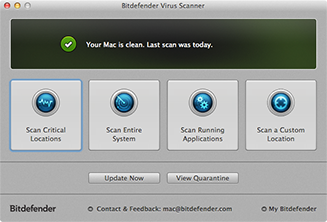
Award-winning Bitdefender antivirus engines; Also: - Quarantines dangerous files; - Deep system scan for all the locations the user has granted access to; - Drag-and-drop scan of files or folders; - Option to exclude files and folders from scan (i.e. Time Machine backups, etc.) - Easy-to-use interface.

Constraints: - Due to sandboxing in the App Store, the app has access only to the locations that the user has explicitly granted access to. Grant access to the entire disk for increased protection; - Disinfection limited by the privileges of the user running the app; - Doesn’t scan programs stored in memory. Wizbang Trainer, Yes, it’s a virus scanner, but it’s not great at disenfection Bitdefender is a very good virus scanner, it will disenfect your hard driveBUT don’t expect it to be able to work on a drive that is not formatted as an HFS drive. I have read reviews of people with windows NTFS drives who are of the opinion that they can connect that drive to their Mac for disinfection. It doesn’t work that way, #1 NTFS uses a different file structure so the OSX program doesn’t know where to put files on that drive to quarantine them because it is configured to work on an HFS drive. People download it on a computer after it is already infected and don’t understand why it won’t update. Um because you have a virus that has disabled the updating.
With either of these issues it’s the user issue with not keeping their system up to date with antivirus software and scanning the hard drive in full every week, with a daily quick scan. This is at a minimum, yes it is much more than most people are used to, but this is also a much differeent world than it was even 12 months ago. Social media bots, websites with malware, it’s all very invasive, and yes there is some malware that once you get it you might as well scrap your hard drive unless you really know how to degauss a hard drive (strong electro magnet that completely obliterates all data on the drive. Wizbang Trainer, Yes, it’s a virus scanner, but it’s not great at disenfection Bitdefender is a very good virus scanner, it will disenfect your hard driveBUT don’t expect it to be able to work on a drive that is not formatted as an HFS drive.
I have read reviews of people with windows NTFS drives who are of the opinion that they can connect that drive to their Mac for disinfection. It doesn’t work that way, #1 NTFS uses a different file structure so the OSX program doesn’t know where to put files on that drive to quarantine them because it is configured to work on an HFS drive. People download it on a computer after it is already infected and don’t understand why it won’t update. Um because you have a virus that has disabled the updating. With either of these issues it’s the user issue with not keeping their system up to date with antivirus software and scanning the hard drive in full every week, with a daily quick scan. This is at a minimum, yes it is much more than most people are used to, but this is also a much differeent world than it was even 12 months ago.
Social media bots, websites with malware, it’s all very invasive, and yes there is some malware that once you get it you might as well scrap your hard drive unless you really know how to degauss a hard drive (strong electro magnet that completely obliterates all data on the drive. “Bob” Dobbs, It works great and the one here is FREE! Bitdefender has a paid version, yes, but this version is not the one that costs money, this version is 100% FREE! “Bitdefender Virus Scanner”, the thing you see here, is the free one. “Bitdefender Antivirus for Mac” (from their website) and “Bitdefender Virus Scanner Plus” (from the Mac App Store) both cost money. Oh and they also have something else free on their website called “Bitdefender Adware Removal Tool for Mac” but it can only remove TWO adware programs, “Genieo' and “Vsearch”, not a very long list, although to be fair, those are the most common ones.
Anyway the point is, there are some other reviews here which are rather negative and complain about being ripped off out of money. Well none of those apply to this product because it is completely free, right here in the Mac App Store it is listed as free, sure there is a “Plus” version that costs money but if you get this free version you will NOT be charged anything. I am trying this along with the free version of Malwarebytes Antimalware, hopefully using both of them can clean up my Mac from an infection of some malware.
“Bob” Dobbs, It works great and the one here is FREE! Bitdefender has a paid version, yes, but this version is not the one that costs money, this version is 100% FREE! “Bitdefender Virus Scanner”, the thing you see here, is the free one.
“Bitdefender Antivirus for Mac” (from their website) and “Bitdefender Virus Scanner Plus” (from the Mac App Store) both cost money. Oh and they also have something else free on their website called “Bitdefender Adware Removal Tool for Mac” but it can only remove TWO adware programs, “Genieo' and “Vsearch”, not a very long list, although to be fair, those are the most common ones. Anyway the point is, there are some other reviews here which are rather negative and complain about being ripped off out of money. Well none of those apply to this product because it is completely free, right here in the Mac App Store it is listed as free, sure there is a “Plus” version that costs money but if you get this free version you will NOT be charged anything.
I am trying this along with the free version of Malwarebytes Antimalware, hopefully using both of them can clean up my Mac from an infection of some malware. Dfom, Easy to install, use and VERY effective I have used Bitdefender for years (Mac only). I am very impressed how Bitdefender has continually improved the ease of installation, updating and use. Very impressive how Bitdefender has reduced the virus deep scan time over the years. If you keep your OS updates current, regularly back ups using Time Machine, run adware and popup blockers in Safari, only download approved software from the App Store, and frequently update and run Bitdefender deep scans, you will significantly decrease your risk of malware exposure.
There are no 100% full-proof security solutions, but conscientious and committed user security practices including Bitdefender come close. Dfom, Easy to install, use and VERY effective I have used Bitdefender for years (Mac only).
I am very impressed how Bitdefender has continually improved the ease of installation, updating and use. Very impressive how Bitdefender has reduced the virus deep scan time over the years.
If you keep your OS updates current, regularly back ups using Time Machine, run adware and popup blockers in Safari, only download approved software from the App Store, and frequently update and run Bitdefender deep scans, you will significantly decrease your risk of malware exposure. There are no 100% full-proof security solutions, but conscientious and committed user security practices including Bitdefender come close.
Advertisement Sadly, Macs aren’t the safe haven they once were. Yes, infections are still less common than on Windows machines, but they do happen.
If your Mac is acting kind of weird—maybe you’re seeing adverts you can’t explain or your system is unreasonably slow—the problem could be malware. Keep reading to learn how to recognize the signs of a virus on your Mac and how to can scan your system. What Is Mac Malware Like?
Mac malware can come in many forms. Here are some recent examples that have generated headlines:. OSX/Dok Malware: If you're a Mac user who looks down on 'virus-prone' Windows users, the newly-dubbed OSX/Dok malware is a wake-up call. Here's how to prevent or remove it.
Is one of the most dangerous Mac viruses seen in the wild. It is spread via a ZIP file email attachment. If run, it replaces the “AppStore” Login Item with itself, allowing it to run every time the system boots. The malware will then prompt you for your admin password, giving it control over your system’s admin rights.
Virus Scan For Mac Osx
Its end goal is to route web traffic through proxy servers so it can impersonate sites. Meltdown and Spectre: Mac computers were left vulnerable from A huge security flaw with Intel CPUs has been uncovered.
Meltdown and Spectre are two new vulnerabilities that affect the CPU. You ARE affected. What can you do about it? Found on Intel chips in early 2018. The bugs allowed a hacker to steal data by using a rogue data cache load. OSX/MaMi: 2018 also saw the arrival of OSX/MaMi.
It let hackers install a new root certificate and hijack the DNS servers, giving them a way to perform “man-in-the-middle” attacks. OSX/Pirrit: In 2016, OSX/Pirrit was discovered. It was hidden in pirated versions of Microsoft Office and Adobe Photoshop. It could access root privileges and automatically install more software.
Learning From These Examples All of these infections have one thing in common: they infect Macs through processes outside of the App Store. In some cases pirated software is to blame; in others it’s software from sources that shouldn’t have been trusted. Put simply—if you never install software from outside the Mac App Store, you don’t have anything to worry about. Sure, there are some browser-related exploits from time to time, and Java is an ongoing concern, but if macOS and browsers are up-to-date such infections are pretty unlikely. And if you do install software from outside the Mac App Store, but are careful to research software before installing it (Googling for a review and finding an official download), you also don’t have anything to worry about.
On the other hand: if you’ve pirated Mac software or installed plugins at the request of a site offering pirated movies, you might have problems. Have you used a tainted USB drive or downloaded a sketchy email attachment? Viruses can spread in unexpected ways. Is your Mac infected? Let’s look at the signs. Unexpected Ads and Pop-Ups Multiple new pieces of have appeared in December, all distributed through different means, but all opening backdoors on infected computers: by — Malwarebytes (@Malwarebytes) Adware is becoming an ever-bigger problem on the Mac platform.
If you’re seeing ads in places they previously didn’t show up, there’s a good chance you’ve installed something you shouldn’t. This is particularly true if you get pop-up ads even when you’re not browsing the internet. Your Mac Is Slow for No Reason Some Mac malware makes your Mac part of a botnet, which is a global network of computers used for all sorts of things. If your Mac is infected, it could be helping to, mine Bitcoins, or any number of things that take up CPU power. If your Mac is constantly slow, even if you don’t have any programs open, this is a possibility. And remember, if malware isn’t the problem, you need to know Is your Mac running slow?
By changing some of your computing habits, you could improve its performance. These 7 big mistakes can slow down your Mac. Malware Scanner Confirms Infection Think your Mac might be infected? Here are a few free programs you can use to scan your Mac and find out about any infections:.: This app is free. It won’t delete infections for you, but it will point out where to delete them using the Finder.: Malwarebytes has been one of the leading names anti-malware world for many years. Its Mac app can scan your entire system in less than 30 seconds and will remove adware and potentially unwanted programs.: ClamXAV is the Mac version of ClamAV, a popular open source malware detection tool.
It’s well worth a look. If none of these tools come up with anything, it’s extremely unlikely that your Mac is infected. As ever, check the app reviews in the App Store to help you make a decision. Of course, there are other apps out there—if you know of something better, let us know in the comments. What Security Do Macs Come With?
Your Mac has defenses in place that should keep you safe from malware, though like all such measures it’s not completely foolproof. Here are a few reasons why you don’t need to worry (much). Gatekeeper macOS is getting further locked down. The Gatekeeper default setting allows only Mac App Store apps and apps signed by Developer ID. Apps will soon have to be notarized to pass upcoming Gatekeeper checks. Apple is implementing a macOS app (cryptographic) whitelist.
— Stephen Hoffman (@HoffmanLabs) Gatekeeper stops uninformed users from installing potentially unsafe software. By default, this means anything not from the Mac App Store, but you can also configure it to block apps from unknown developers. Of course, many Mac users disable Gatekeeper completely so they can run whatever software they like, including things they’ve compiled themselves. The hope is that well-informed users will research the apps they run before installing it. Sandboxing Apps installed through the Mac App Store have very limited access to the broader system, a limitation intended to stop one app from messing up your entire system. XProtect XProtect is the anti-malware program you didn’t know you had.
Part of OS X since 2009, this program isn’t like Windows anti-viruses—it’s completely invisible to most users. You can’t open the program and run a scan yourself, and you can’t manually install updates. But if you’re infected with a known virus, odds are this program will eventually notify you. It also stops you from opening infected files. Recommended Mac Antivirus Apps You should now recognize whether your Mac has been infected with malware.
However, prevention is nine-tenths of the cure, as they say. If you want to make sure you never have to worry about malware on Mac, you should install a By now, you should know that Macs need antivirus software, but which one should you choose? These nine security suites will help you stay free of viruses, trojans, and all other sorts of malware.
Explore more about:,. Let me start out by stating that I am not a Mac user. However, please note that this is not some part of the Mac vs.
Pc war, I just don't need one. In addition, computers are tools and you use the right tool for the job. Against popular (put horribly incorrect) belief, the Mac OS is NOT immune to viruses, spyware, or any sort of malware for that case. So yes, you can get spyware on your Mac. The reason why so many egotistical Mac users have decided to tell uninformed users that there are no bugs for Mac, is because there are significantly less than Windows OS. Malware writers, as well as script kiddies, want to target the largest population, so they take out Window's boxes.
On the other hand, UNIX kernels, which is what Macs are based off of, as are Linux distros, is, in my opinion, more secure than the Window's equivalent. At any rate, on to your question. There are anti-virus, etc. Programs for Mac. I routinely run Linux, and while it has little malware, I still run an AV.
You can tell that you have some sort of a bug if just random things start happening. If your computer is running extremely slow, check the processes (Not sure how on Mac, ps -A on Linux, so may be the same) and see if any of them seem suspicious.
While most of the times a keylogger will not be called keylogger.exe, there are a lot of novice script-kiddies out there. If you see a lot of TCP or UDP connections (maybe netstat?) on strange ports, that could be a sign. Also, if you see any data being moved along port 0, that could be a problem.
But most importantly, run your AV. I know that there are some free ones out there. I know that McAffee (I think) or one of the major companies has started making a mac Av, so you might consider it.
Sorry for the long run on. Email me if you need anything and Good Luck.
I've tried everything and my problem has not been solved. I keep seeing popups on my browser, usually when I'm being redirected by a link. They are all from Mackeeper, and they all force me to quit Safari. I did not install anything on my computer, other than Adobe. I've searched everywhere for a way to keep the ads from appearing, but I have not found a solution yet.
I downloaded and installed Malwarebytes but it has not found anything. I've followed instructions that said to delete certain files from the Library, but I don't have any of the ones mentioned. I've tried switching networks and the problem just won't go away. Justin, Good morning! I removed 2 different Mac viruses in my first six months (I remember because it surprised me so much), and I was only put in charge of about 30 Macs. I wouldn't call them common, but they are just as easy to get and they're just as bad.
Go to a shady website, or stick in a flash drive from a co-worker and whammo, you're infected. The best way to describe it is the two 'S' words: MacOS is safer, but not more secure. Safer in the odds - they are far lower you'll contract a virus. But not any more secure in that when a virus wants to get in, it most certainly will (assuming you are not protected). Check out Apple's very own security updates page: Often, they release security updates several times a month. That should tell you something about the current and active status of malware on the Mac.
Hope that helps! Stay safe out there. I think that telling Mac owners they 'probably aren't' infected is not wise. I was a consultant for a Mac-only IT company, and I personally removed viruses from Macs during that time. They are computers.
They are no different from any other computer in that they are susceptible to viruses through all of the same channels. Including websites, external storage, email, and local area networks. Merely sticking to software downloads from the App Store is not enough to protect you. If you own a Mac, please get and use a good AV product!

(To add to Justin's list, ESET also makes a decent Mac AV product.).